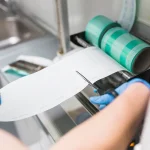
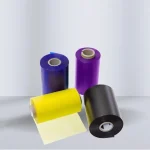
There are two main printing technologies used in barcode printers: Direct Thermal, which darkens with heat, and Thermal Transfer, which prints using an inked ribbon (ribbon). Each has areas where it excels—and where it falls short. The fundamental difference lies in print durability and the environmental conditions the label will be exposed to.
1. Direct Thermal Label: Speed and Practicality
In this method, there is no ink, toner, or ribbon. The label surface itself is coated with a special layer that reacts chemically and darkens when exposed to heat. As soon as the printhead touches the label, the required pixels heat up and the print forms instantly.
Advantages:
There is no additional consumable cost such as ribbon. The printer mechanism is simpler, so roll changes take only seconds. It provides significant practicality, especially in field operations and fast-paced packaging lines.
Disadvantages:
These labels are “living” materials. They are highly sensitive to sunlight, temperatures above room level, and friction. If you leave a label near a sunny window, you will see the entire surface darken.
Lifespan:
Generally between 3 to 6 months. After this period, the print begins to fade and the paper may yellow.
Who Should Choose It?
If your product will not remain on shelves or in storage for years—for example, shipping and logistics labels, daily fresh food (butcher/deli) labels, hospital record barcodes, or short-term ticketing systems—Direct Thermal is the most logical and cost-efficient choice.
2. Thermal Transfer Label: Durability and Quality
In this method, there is an inked ribbon placed between the printhead and the label. The printhead heats up and melts the solid ink (wax or resin) on the ribbon, effectively bonding it onto the label surface.
Advantages:
It can print not only on paper but also on plastic (PP), fabric (non-woven), metallized, or transparent surfaces. It is highly resistant to sunlight, moisture, chemical solvents, and harsh outdoor conditions. Prints can remain clear and legible for years—even decades.
Disadvantages:
Ribbon adds an extra consumable cost. Since both label and ribbon must be installed, the setup process requires slightly more attention.
Lifespan:
Depending on the ribbon type, prints can remain readable from 1 year up to 10 years or even longer.
Who Should Choose It?
If your product will be exposed to outdoor environments (construction sites, gardens, external warehouses) or used in demanding industries such as heavy manufacturing, textiles, or automotive, Thermal Transfer is essential. It is ideal for asset labels, textile care labels, chemical drum labels, and cosmetic products.
Critical Differences to Help You Decide
If you are still unsure which method to choose, ask yourself these three key questions that will shape your operational future:
- Will the label be exposed to sunlight, moisture, or friction?
If yes: Definitely choose Thermal Transfer. A direct thermal label can become completely unreadable inside a hot delivery vehicle or on a friction-heavy conveyor belt. - How long does the information need to remain readable?
- A few weeks or months: Direct Thermal is sufficient.
- 1 year or more: Thermal Transfer is the safe harbor.
- What should the label surface be?
- Paper only (Eco Thermal or Laminated Thermal): Both methods are suitable.
- Plastic (Vellum, PP, PE), Metallized, or Fabric: Only Thermal Transfer can print on these materials.
2026 Cost-Saving Note and Strategic Perspective
In 2026, managing logistics costs and return processes will be one of the most critical factors determining profit margins. Many businesses choose Direct Thermal to avoid ribbon expenses. However, it should not be forgotten that a faded barcode in the warehouse after 6 months—or a returned shipment due to an unreadable address—can cost ten times more than a single ribbon roll.
Expert Recommendation:
If you operate in e-commerce and your package reaches the customer within 2–3 days, use Direct Thermal for speed and efficiency. However, if you are a manufacturer and your products remain in dealerships, on shelves, or in cold storage for months, do not risk your brand image and traceability with a faded label. Choose Thermal Transfer and secure your business.