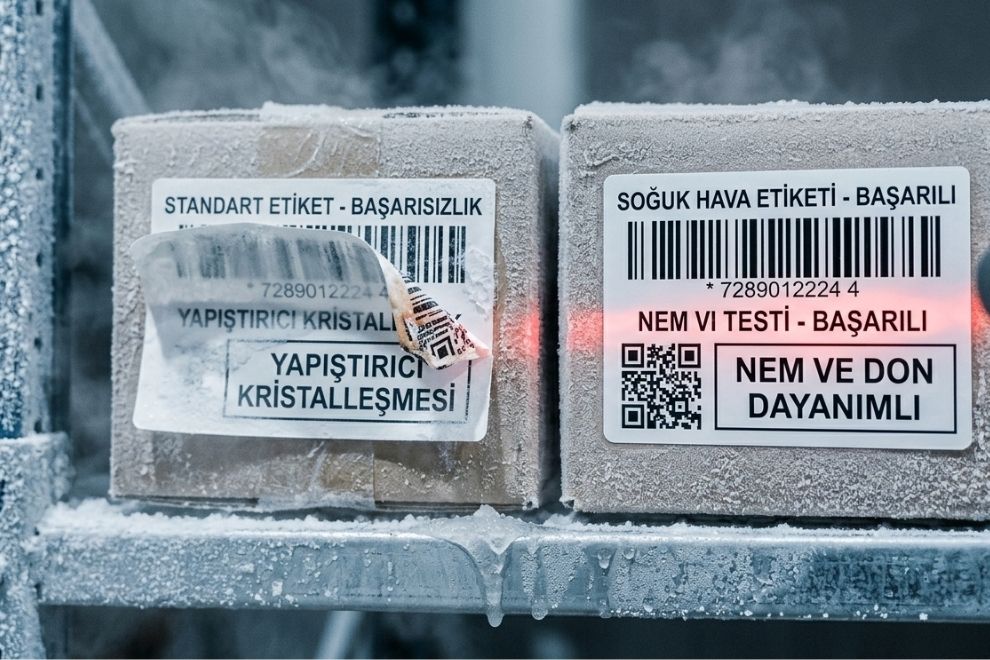
Cold chain logistics, constituting one of the most critical and sensitive links in supply chain management, guarantees that fresh foods, frozen products, vaccines, and biomedical drugs are delivered to the final consumer without losing their structural properties. The tracking, traceability, and management of these valuable loads, which must be preserved under specific temperature limits, depend entirely on the barcoded labels they carry. However, ordinary box and product labels manufactured for standard storage conditions rapidly lose their structural properties when entering freezers and cold storage units with sub-zero temperatures. Intense humidity, surface crystallization (frosting), and extremely low temperatures cause standard adhesives to dry out, freeze into crystals, and the labels to suddenly fall off the packaging surface.
In a logistics center or pharmaceutical warehouse, labels falling off means that unidentified products cannot be distinguished, shipments get mixed up, and operations come to a complete standstill. Therefore, using special acrylic and deep-freeze label solutions that do not lose their adhesiveness at sub-zero temperatures is the most fundamental requirement for supply chain security in food and pharmaceutical logistics.
Criteria for Choosing the Right Label in Harsh Cold Weather Conditions
To create a long-lasting labeling scheme compliant with cold chain standards, it is necessary to accurately analyze the physical conditions of the industrial site rather than making rote material choices. To achieve full performance in sub-zero temperatures and humid environments, the following technical parameters should be considered:
-
Special Deep Freeze Acrylic Adhesive Technology: Standard label adhesives lose their flexibility at temperatures below +5°C, harden like glass, and fail to adhere to the surface. However, special Hotmelt or acrylic-based “Deep Freeze” adhesives developed for cold storage maintain their fluidity and high bonding strength even at extreme freezing temperatures like -20°C to -40°C.
-
Moisture and Condensation Resistance (Polypropylene and Polyethylene Surfaces): Condensation (sweating) occurs on the surface of packages that come off a hot production line and suddenly enter cold storage, or exit the cold and are loaded onto a dispatch vehicle. Paper-based labels absorb this moisture, become pulpy, and tear. For this reason, synthetic label surfaces based on Polypropylene (PP) or Polyethylene (PE) plastics, which are resistant to water, moisture, and tearing, should be preferred in cold storage.
-
The Difference Between Application Temperature and Service Temperature: The biggest mistake made in label selection is confusing these two temperature values. The ambient temperature at the moment the product is labeled (Application Temperature) and the temperature at which the label will be stored after application (Service Temperature) have different dynamics. If the labeling process is to be done directly inside a sub-zero warehouse, it is essential to choose special “cryogenic” or “deep freeze” labels with aggressive adhesives that can instantly adhere to frozen and frosted surfaces.
Global Hardware Solutions Supporting Cold Chain Operations
Just as important as choosing the right cold chain label is the clarity of the QR codes and barcodes to be printed on these labels, as well as the field control of this data. Equipment freezing or screens responding with a delay in harsh sub-zero environments slows down the operation. Today, the global technologies that set industrial cold chain standards and perfect this process from end to end are as follows:
High-Resolution Thermal Transfer Printers
To prevent prints on plastic-based synthetic (PP/PE) deep freeze labels from being wiped off by moisture or friction, they must be printed using the thermal transfer method with resin-based ribbons. In large food and pharmaceutical warehouses operating uninterruptedly throughout the day, the metal-framed armored Zebra ZT231, Zebra ZT411, and the ultra-durable Zebra ZT610 industrial series designed for the heaviest field conditions produce high-resolution, clear barcode outputs, engraving flawless pixels onto deep freeze labels. The Honeywell PM45 industrial series, known for its smart mechanical structure, and the Honeywell PC42t models, which offer budget-friendly solutions for coated and thermal label printing, are also indispensable for warehouse processes. For light cargo and sample labeling in the office, the strong players of the desktop segment, the Zebra ZD220 and Zebra ZD421 series, balance the costs.
Industrial Handheld Terminals Compatible with Cold Storage
When ordinary handheld terminals enter cold storage, their screens freeze, short circuits occur in their internal components due to condensation, and their batteries drain within minutes. Special handheld terminals manufactured for these areas, however, have heated screens and scanner windows, along with internal insulation systems that prevent condensation. The industrial Zebra MC3300 series, offering physical keyboard and gun support, is the most powerful mobile computer that enables personnel to work flawlessly even with gloves in cold storage. For lighter logistics processes and field distributions, the Android-based Zebra TC21 and the cellular data-supported Zebra TC26 models are used, while the Honeywell EDA52 model, known for its long battery life, accelerates data flow.
Precision Scanning Technologies and Automatic Labeling Systems
To read QR codes left under snow or stretch film in cold rooms without the operator getting out of the forklift seat, the corded Zebra DS3608 and cordless Zebra DS3678 ultra-durable industrial scanners scan from meters away with their “ER” (Extended Range) engines. While the corded Zebra DS2208 and cordless Zebra DS2278 models complete the ecosystem on standard packaging tables; the Datalogic PowerScan and Datalogic QuickScan series featuring patented green spot verification technology, along with the scanning expert Honeywell Voyager 1250g, Honeywell Xenon Ultra, and the armored-body Honeywell Granit series scanners, can instantly decode any challenging 1D/2D codes.
The Bizerba GLP and Bizerba GLM-I series automatic labeling systems, which are global leaders in automatic weighing logistics lines following food production, accelerate shipments by instantly printing weight data onto deep freeze labels. On massive packaging lines, the Weber Alpha Entry, Weber Alpha Compact—which stand out with their modular structures—and the premium Weber Alpha HSM labeling systems that can reach extreme speeds like 2,000 labels per minute, ensure that special acrylic-based labels are applied onto product packaging on the conveyor belt with pinpoint accuracy.
Practical Advice to Increase Label Efficiency in the Cold Chain
After investing in the right hardware and deep freeze label combination, preventing labels from falling off surfaces and keeping scanning quality high in the field depends on a few practical steps that businesses should pay attention to:
-
Prevention of Surface Residues: There should be no excessive icing, snow, or thick water layers on the packages or boxes to be labeled. Even aggressive deep freeze adhesives can struggle to adhere to a surface completely covered in ice. If possible, the labeling process should be completed before the products enter the freezing room, meaning before surface frosting occurs.
-
Correct Ribbon Matching and Darkness Adjustment: Resin ribbons must absolutely be used so that the prints made on synthetic PP/PE deep freeze labels are not scraped off in sub-zero temperatures or do not run when exposed to moisture. Optimizing the darkness settings via software preserves the life of the printhead while keeping barcode clarity at a maximum.
-
Maintenance of Hardware Lenses: Fogging may occur on the optical windows of handheld terminals and scanners during transitions from cold rooms to warm rooms. Periodically cleaning these glass panels using non-abrasive microfiber cloths keeps the first-time read rate of the devices high, preventing time losses.
Reliable Cold Chain Automation with DGS Printing Technologies
Achieving a sustainable workflow in the harsh environmental conditions of cold storage is possible not only by supplying boxed hardware or consumables, but through accurate material analysis, system integration, and strong after-sales support. Maintaining your business’s operational quality while optimizing your budget in the long run requires a professional partner with technical depth in this field, backed by the power of global brands.
DGS Printing Technologies (dgs.com.tr) offers the most comprehensive solutions for your labeling needs in food and pharmaceutical logistics with its large stock of original spare parts, rich hardware portfolio suitable for cold weather conditions, and sectoral experience. While delivering Zebra, Honeywell, Datalogic, Bizerba, and Weber handheld terminals, barcode scanners, printers, and automatic labeling systems best suited to your industry’s dynamics, your warehouse’s temperature values, and your packaging structures to your business, we also prepare alternatives that best fit your budget planning.
Going beyond being merely a supplier that sells products, DGS stands by you full-time with its expert technical service staff during fault detection, parts replacement, device calibration, system integration, and periodic maintenance processes. We manage the hardware and software updates that will keep your devices’ performance at the highest level, minimizing your operational downtime and erroneous shipment rates. You can trust DGS’s expertise and modern technologies to achieve uninterrupted data flow in today’s fiercely competitive conditions, to prevent losses caused by falling labels in cold chain processes, and to experience the comfort of professional technical support. DGS is your reliable and expert guide at all times for all your technical service, consumables, and data collection device requests.