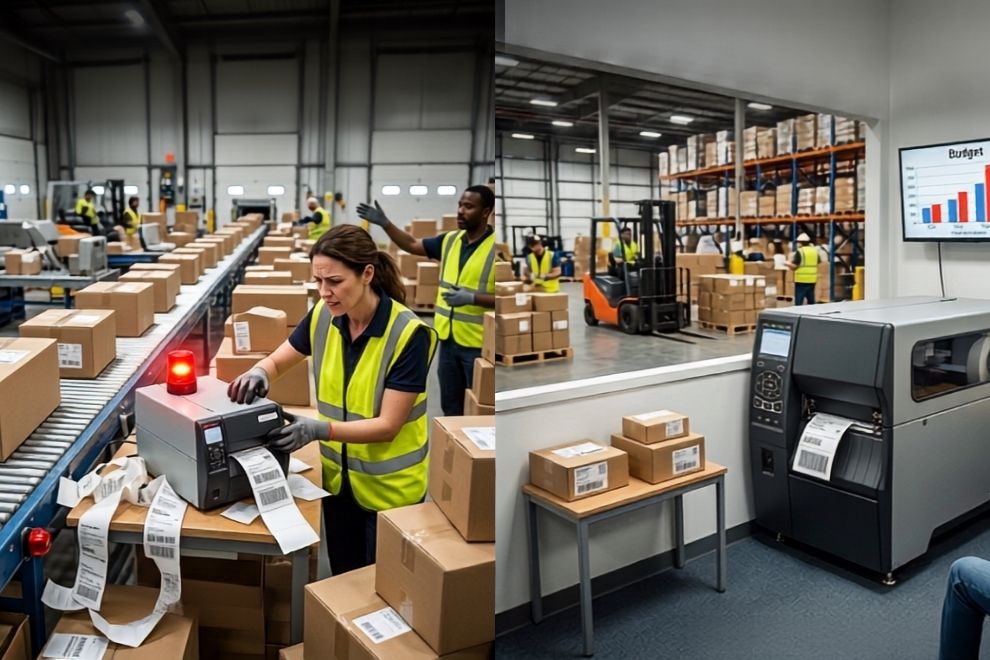
In industrial production lines, e-commerce logistics centers, and modern retail warehouses, the error-free progression of operations depends entirely on the correct labeling of products and boxes. Barcode printers, the backbone of data printing processes, are one of the most critical investments ensuring the uninterrupted flow of the supply chain. However, when making this hardware investment, businesses often focus solely on the initial purchase cost or the popularity of the devices. Choices made without analyzing technical details, daily print volumes, and the physical conditions of the working environment quickly lead to high-cost malfunctions, labor losses, and operational inefficiency.
Choosing a device in the wrong segment and wasting budget when it is not needed, or positioning an insufficient model on an intense production line, is one of the most common mistakes in operational processes. Ensuring the right hardware match prevents unnecessary spare parts expenditures while maintaining your business’s overall efficiency standards at the highest level.
Most Common Critical Mistakes in Barcode Printer Selection
When making a technological data printing investment for your business, you need to correctly analyze your operational needs instead of making rote decisions to protect your budget and achieve full performance. The biggest traps fallen into when choosing hardware in the sector include:
- Incorrect Volume Analysis (Desktop vs. Industrial Segment Confusion): The most common mistake is miscalculating the daily required label quantities. Buying massive industrial models for an office environment that prints only 100-200 shipping labels a day is a huge waste of budget. Conversely, placing a plastic-bodied desktop model on a dusty, continuously operating factory line that produces thousands of labels a day is an equally grave mistake. Insufficiently segmented devices cause continuous mechanical failures under intense workloads, stalling the workflow.
- Ignoring Printing Technology and Consumables: Not knowing the difference between direct thermal (ribbonless) and thermal transfer (ribbon-based) printing technologies leads to serious long-term damage. Applying heat- and light-sensitive direct thermal labels to products that will stand outdoors or be exposed to chemical substances results in barcodes fading quickly and shipments being rejected.
- Wrong Resolution (DPI) Selection: While a 203 DPI resolution offers sufficient performance for standard shipping and box labels, 300 or 600 DPI resolution printers must be preferred for small electronic components, medicine boxes, or micro QR code (2D) printing. Trying to print a small QR code with a low-resolution device causes the codes to bleed and become unreadable by barcode scanners.
- Overlooking Connection and Integration Infrastructure: Placing a printer with only USB support on a warehouse line used by multiple personnel over the network slows down operations. In today’s digitalizing factories, having Ethernet or Wi-Fi connectivity is essential for devices to work in full synchronization with WMS (Warehouse Management System) and ERP systems.
Reliable Industry Solutions for the Right Match
To achieve sustainable performance and maintain operational quality in data printing processes, it is necessary to turn to the right segments of models from globally proven brands. The prominent device categories setting industrial labeling standards today include:
Desktop Barcode Printers (Light and Medium Intensity Areas)
The desktop segment offers budget-friendly and practical solutions for in-office shipping labeling, retail stores, pharmacies, and small-scale warehouses. Industry pioneers like the Zebra ZD220 and the Zebra ZD421, which incorporates advanced features into its hardware, provide high efficiency in daily light-to-medium printing processes while taking up minimal space with their compact designs. The Honeywell PC42t series, which brings a high cost advantage in vellum and thermal label printing, is also one of the most reliable alternatives for entry-level budgets.
Industrial Barcode Printers (Heavy Industry and Massive Logistics Lines)
Armored models with metal bodies should be preferred for factories that need to operate 24/7, large distribution centers, and challenging industrial sites like automotive and chemical sectors. In this segment, the Zebra ZT231 and Zebra ZT411 series offer uninterrupted printing performance with their high speeds and durable mechanical structures. Developed for the extreme points of heavy industry, the ultra-durable Zebra ZT610 series and the Honeywell PM45 models with smart printer features reduce operational errors to zero by producing high-resolution and millimeter-accurate QR code prints.
Automatic Labeling and Mobile Data Collection Integrations
Bizerba GLP and Bizerba GLM-I series automatic labeling systems, world leaders in weighing logistics processes and food automation, convert weight and barcode data into physical labels within seconds. In massive packaging lines, the Weber Alpha Entry with its modular structure, the Weber Alpha Compact with its flexible design, and the premium Weber Alpha HSM labeling systems capable of reaching extreme speeds like 2,000 labels per minute ensure that new-generation labels are applied onto packages without error.
For the on-site control of these printed labels and their instant transfer to the WMS system, Android-based Zebra TC21, cellular-data-supported Zebra TC26, and industrial Zebra MC3300 mobile computers with physical keyboard support, along with long-battery-life Honeywell EDA52 models, complete the ecosystem flawlessly. On the scanning side, wired Zebra DS2208, wireless Zebra DS2278, armored Zebra DS3608 / Zebra DS3678 series, and Datalogic PowerScan, Datalogic QuickScan featuring patented green spot technology, as well as Honeywell Voyager 1250g, Honeywell Xenon Ultra, and industrial Honeywell Granit scanner models make the data flow seamless.
Technical Recommendations to Protect Barcode Printer Performance and Lifespan
After selecting the device belonging to the correct segment, ensuring that this hardware works at high performance at all times in the field and optimizing consumable costs depends on the businesses’ own routines:
- Periodic Cleaning of the Printhead: The most sensitive and costly component of barcode printers is the thermal printhead. Dust from label rolls and ribbons, along with ink residue, accumulates on the head over time, leading to pixel burnouts (print losses in the form of lines). Gently wiping the printhead with special alcohol cleaning pens during every roll change directly extends the lifespan of the device.
- Platen Roller and Sensor Maintenance: If the rubber platen roller, which ensures the smooth flow of the label inside the device, is not cleaned regularly, it causes labels to slip and ruins print calibration. Additionally, clearing the optical sensors that detect label gaps from warehouse dust prevents the device from constantly giving “label missing” errors.
- Right Ribbon and Label Compatibility: Harsh or low-quality label surfaces accelerate wear by applying extra friction to the printhead. Choosing the correct ribbon combination (Wax, Wax-Resin, or Resin) suitable for your print type both ensures crisp barcode outputs and protects hardware health.
Right Hardware Investment with DGS Printing Technologies
Achieving a sustainable workflow in the world of automation and data printing is possible not just by purchasing boxed products, but through determining the correct device segment, system integration, and strong post-sales support. Optimizing your budget while protecting your business’s operational quality requires a partner with technical depth in this field and the backing of global brands.
DGS Printing Technologies (dgs.com.tr) offers the most comprehensive solutions for your barcode printer and labeling needs with its wide spare parts inventory, rich product pool containing world-leading brands, and sectoral experience. While delivering the Zebra, Honeywell, Bizerba, and Weber models most suitable for your industry’s dynamics, working intensity, and daily print volume to your business, we also prepare the most suitable alternatives for your budget planning.
Far beyond being a supplier that just sells products, DGS stands by you full-time with its expert technical service team in troubleshooting, original parts replacement (printhead, platen roller, sensor), software integration, and periodic maintenance processes. To achieve uninterrupted data flow in today’s challenging competitive conditions, prevent budget losses caused by wrong device selection, and experience the comfort of professional technical support, you can trust the expertise and modern technologies of DGS. DGS is your reliable and expert guide at any moment for all your technical service and hardware demands.