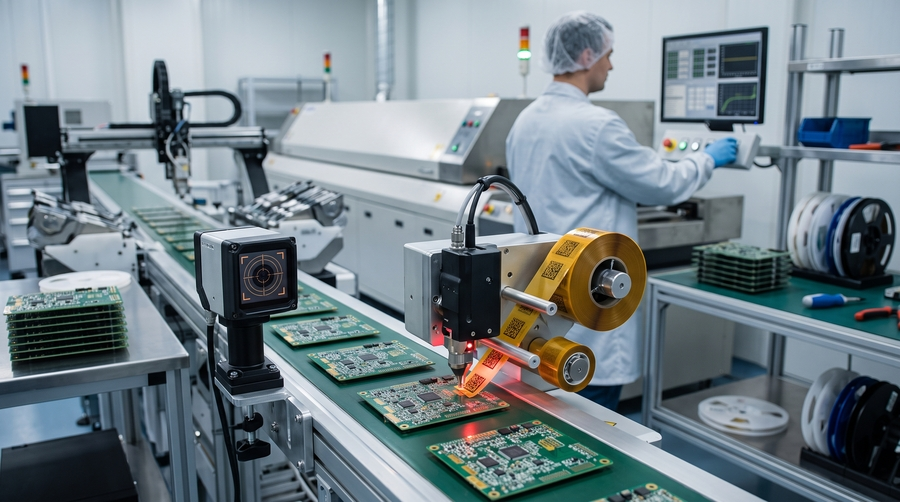
In modern electronics manufacturing, where printed circuit boards (PCBs) are populated with micro-scale components and nano-scale soldering operations race against milliseconds, the cost of an error translates directly into scrapped components. A single motherboard, automotive ECU, or defense industry control unit passing through surface-mount technology (SMT) lines undergoes aggressive thermomechanical stages such as reflow soldering, wave soldering, and chemical wash cycles. Under today’s demanding industrial manufacturing conditions, identifying circuits exposed to these infernal temperatures, recording manufacturing history, and maintaining component-level traceability is absolutely impossible with standard labels.
Temperatures reaching hundreds of degrees in reflow ovens instantly char, shrink, or completely melt the barcode pattern on conventional polyethylene or paper labels. At this stage, high-performance polyimide-based heat-resistant labels applied to circuit boards act as a vital shield throughout the demanding journey of electronic assemblies. Whether it is a millimeter-sized 2D DataMatrix code or a delicate serial number, the label’s ability to retain readability after exiting the solder oven directly determines batch quality-control approval and full compliance with global standards.
Polyimide Label Material Dynamics in SMT and Reflow Ovens
Polyimide films (commonly known as Kapton® derivatives), preferred in electronic assembly processes requiring high-temperature resistance, exhibit outstanding thermal stability due to their molecular structure. The ability of these labels to adhere without melting, burning, or losing adhesive integrity on production lines relies on the following critical layer architecture:
- Extreme Temperature Tolerance: Polyimide labels withstand peak oven temperatures between +260°C and +300°C for several minutes under lead-free soldering standards, and endure instantaneous thermal shocks up to +350°C without losing structural form. No shrinkage, yellowing, or blistering occurs on the surface.
- Corrosive Flux and Solvent Resistance: Aggressive chemical solvents, ultrasonic wash baths, and acidic flux agents used to clean residues off circuit boards post-soldering strip standard labels away. The polyimide topcoat provides comprehensive protection against these chemical washes, preventing the printed label surface from rubbing off.
- Anti-Static (ESD-Safe) Adhesive Layer: The most insidious threat to electronic boards is electrostatic discharge (ESD). Static electricity generated when peeling a label off its liner can destroy sensitive microchips within seconds. Electronics-grade heat-resistant labels do not generate static charge during peeling thanks to specialized ESD-protective adhesive formulations, thereby safeguarding circuit elements.
Micro 2D Codes and Resolution Standards in Circuit Board Traceability
Space conservation is paramount on electronics manufacturing lines. The area available for labeling on smartphone logic boards or miniature sensor circuits rarely exceeds a few square millimeters (such as 2×2 mm or 3×3 mm). To fit both the serial number and manufacturer code into such constrained footprints, GS1 DataMatrix 2D micro barcodes are utilized.
For these micro 2D codes to be decoded accurately by automated optical inspection (AOI) stations after exiting the reflow oven, the following parameters must be met without exception:
- Ultra-High-Resolution Printing: Standard 203 DPI printers are insufficient to maintain the readability of micro symbols; an industrial barcode printer equipped with a 300 or 600 DPI print engine is an absolute requirement.
- Specialized Full Resin Ribbon Combination: The ink transferred to the heat-resistant polyimide surface must also withstand reflow temperatures. While standard ribbons melt, high-temperature-rated specialty Full Resin ribbons chemically fuse with the polyimide film, creating an abrasion-proof finish.
- Flawless Contrast: The matte white or gloss white top surface of polyimide labels must not discolor under extreme heat, ensuring the contrast ratio between black DataMatrix pixels and the background remains uncompromised.
Global Hardware Fleets Powering Electronics Manufacturing Lines
Seamless execution of micro-labeling processes across electronics manufacturing plants relies on the integration of heavy-duty industrial printers, high-precision scanners, and automated applicators. Key technologies deployed across world-leading electronics facilities include:
High-Resolution Industrial Barcode Printers
Devices with high mechanical precision are essential for smooth printing on micron-level polyimide labels. The armored Zebra ZT610 series, operating 24/7 alongside SMT lines (especially in its 600 DPI printhead configuration), renders pixels with exceptional clarity on micro-circuit labels. The metal-framed Zebra ZT411, proven for factory-floor durability, and the robust mid-tier Zebra ZT231 print circuit labels flawlessly when paired with industrial Resin ribbons.
The Honeywell PM45 industrial series with its smart mechanical chassis, alongside the Honeywell PC42t models delivering high performance on coated and thermal shipping labels, represent indispensable assets for facility logistics. In laboratory environments, board-testing rooms, and desktop labeling stations, the compact Zebra ZD421 and Zebra ZD220 desktop printer models optimize both budget and footprint with their precision printing capabilities.
High-Precision Barcode Scanner Systems for Instant Micro-Code Decoding
Reading tiny DataMatrix codes on hot boards emerging from solder ovens demands superior optical performance. At packaging and test benches, the corded Zebra DS2208 and cordless Zebra DS2278 ensure stable reads on reflective solder surfaces, while the ruggedized corded Zebra DS3608 and cordless Zebra DS3678 series—equipped with high-density (HD) optical lenses—decode even the smallest micro codes in a single pass.
The Datalogic PowerScan and Datalogic QuickScan series, which confirm successful reads instantly via patented Green Spot feedback technology, alongside scan engine specialists such as the Honeywell Voyager 1250g, Honeywell Xenon Ultra, and the ultra-rugged Honeywell Granit barcode scanner series, eliminate data collection errors across electronic assembly lines.
Industrial Mobile Terminals and Automatic Label Applicators
Equipment communicating in real time with warehouse management systems (WMS) is essential for in-plant component counting, case dispatch, and assembly line material replenishment. Providing ergonomic comfort with physical keypad support, the rugged Zebra MC3300 mobile computer serves as an indispensable field asset. For field dispatch, board logistics, and mobile workflows, the Android-based Zebra TC21, cellular-enabled Zebra TC26, and extended-battery Honeywell EDA52 mobile terminals deliver uninterrupted data transmission.
On automated conveyor lines, Weber modular applicators take center stage for touch-free labeling of boards and packaging. The cost-effective Weber Alpha Entry for entry-level tasks, the Weber Alpha Compact adapting swiftly to variable conveyor angles, and the high-speed Weber Alpha HSM modular systems labeling thousands of packages per minute with millimeter accuracy significantly reduce factory cycle times. For automated board packaging and master carton verification, dynamic weighing automation leaders Bizerba GLP and Bizerba GLM-I systems complete the workflow seamlessly.
Recommendations for Extending Printhead and Hardware Lifespan on Electronics Lines
High-temperature labels and Resin ribbons demand higher printhead pressure and heat transfer compared to standard paper labels, which can compromise the operational lifespan of printing components. To preserve line productivity, implement the following practices:
- Balanced Printhead Temperature (Darkness) Calibration: While heat is required for Resin ribbon to fuse securely to polyimide, excessively high heat settings burn out thermal printhead pixels prematurely. Optimize the balance between speed and darkness in software, operating at the lowest effective temperature.
- Cleaning Chemical and Adhesive Residues on Rollers and Printheads: Microscopic adhesive bleed from the edges of polyimide labels can accumulate on the rubber platen roller. Cleaning the printhead and platen roller with isopropyl alcohol during every ribbon change prevents scuffing, scratches, and label slippage.
- Optical Lens Maintenance: Airborne fumes and flux vapors around SMT reflow ovens can form a thin film over nearby barcode scanner lenses. Wiping scanner exit windows with anti-static microfiber cloths ensures first-time read rates remain consistently high.
Zero-Defect Traceability in Electronics Manufacturing with DGS Printing Technologies
Achieving sustainable quality standards in an electronics industry built on ultra-precision and zero-defect mandates requires more than sourcing consumables alone; it demands an engineering mindset attuned to circuit manufacturing dynamics, certified polyimide label sourcing, and robust technical field support.
DGS Printing Technologies (dgs.com.tr) delivers end-to-end traceability solutions to electronics manufacturers through an industrial portfolio featuring high-temperature flame-retardant labels fully compliant with demanding solder reflow profiles, anti-static consumables, and rugged hardware. We supply your operations with the most suitable Zebra, Honeywell, Datalogic, Bizerba, and Weber industrial barcode printers, automated applicators, mobile computers, and high-density scanning systems tailored to your line speed, oven temperature profile, and board architecture—all backed by cost-efficient, flexible supply models.
Beyond acting as a hardware provider, DGS supports your operations with dedicated technical service engineers providing on-site commissioning, production line integration, genuine spare parts supply (600 DPI printheads, platen rollers, optical sensors), and routine calibration services. In today’s competitive electronics manufacturing landscape, count on DGS’s modern technologies and engineering expertise to eliminate component loss and achieve global standards in board-level traceability. For all high-temperature labeling, hardware, label printing, and technical service requirements, DGS stands ready as your dedicated solution partner.