Tire manufacturing and supply chain operations represent one of the most demanding proving grounds in the global automotive industry—a unique ecosystem combining complex chemical compositions with severe mechanical conditions. Emerging from factory vulcanization molds, raw rubber surfaces immediately repel standard labeling solutions due to their coarse textures, protective oils migrating to the surface, and high elasticity. Assigning a finished tire to warehouse racking, classifying it under international mandates, and delivering it to vehicle assembly plants hinges entirely on the identity credentials affixed to its tread. In today’s exacting market conditions, a missing or illegible label means rejected shipments worth substantial capital and stalled assembly lines across automotive OEMs.
The foundation of this critical operational workflow rests on durable tire labels developed through dedicated material engineering. Chemically bonding directly to coarse, oily tread patterns where conventional adhesives fail, modern tire label solutions serve not merely as inventory control tags; they function as strategic compliance certificates carrying mandatory EU tire label ratings, verifying fuel efficiency classes, and documenting wet grip capabilities. Meeting tire label standards across the automotive supply industry is fundamental to achieving an error-free supply chain and maintaining certified global production.
Challenges of Rubber Surfaces and Specialized Tire Label Architecture
The chemical composition of passenger car, commercial vehicle, heavy machinery, or motorcycle tires differs entirely from standard packaging substrates. Natural oils, sulfur, and plasticizers within rubber compounds continuously migrate toward the exterior surface over time. This migration degrades standard adhesives, causing them to liquefy or dry out and detach completely. High-performance industrial tire labels are engineered with a three-layer technical architecture:
- Aggressive Tyre (Rubber-Based Hotmelt) Adhesive Layer: Conventional acrylic adhesives cannot establish surface contact with uneven tread profiles. Formulated specifically for the tire sector with high coating weights (50–60 g/m²), Hotmelt rubber adhesive flows into the micro-crevices of the tire tread. It bonds instantly to oily, dusty, and irregular surfaces, preventing the label from peeling off during transport, rough handling, or high-density stacking.
- Aluminum Foil Barrier Layer: Migrating process oils and carbon black particulates within the rubber compound tend to penetrate the adhesive layer and travel toward the upper facestock. Without an impenetrable barrier, these hydrocarbons stain paper or standard film surfaces, rendering barcodes unreadable. A micro-thin aluminum foil barrier laminated between the facestock and adhesive halts chemical migration, keeping the tire label bright white and legibly scannable for years.
- Polypropylene (PP) or Coated Thermal Transfer Facestock: Exposed to heavy friction, open-air yard storage, UV radiation, and high humidity, the top facestock is manufactured from tear-proof synthetic PP film. This durable layer maintains dimensional stability even under the most demanding warehouse and shipping conditions.
European Union (EU) Tire Labeling Regulation Requirements
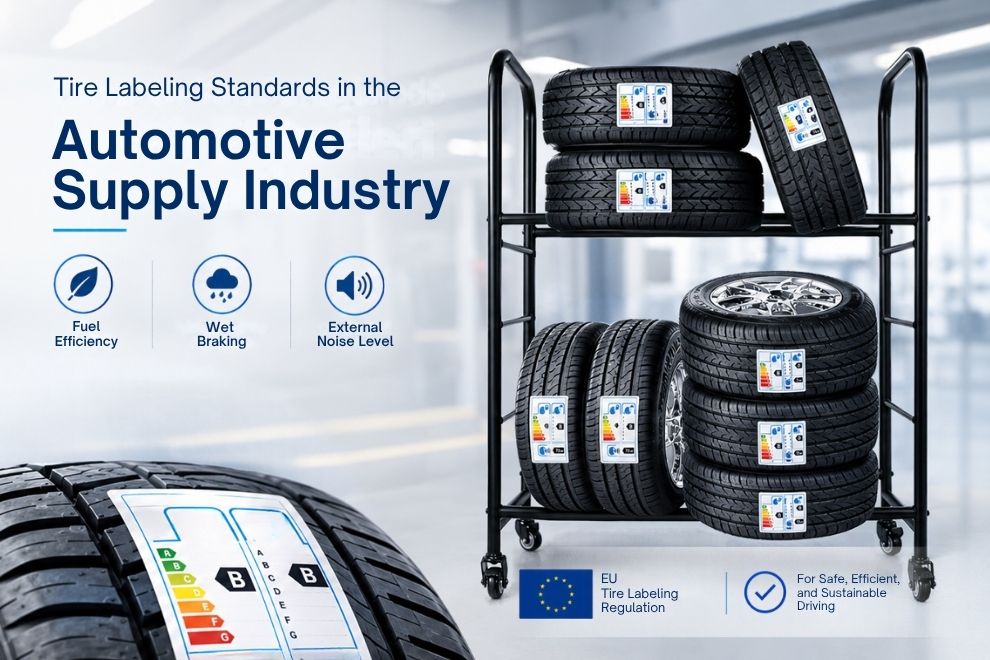
Under updated international frameworks, every tire manufactured for the automotive supply chain must legally display standardized regulatory labeling to inform consumers and vehicle manufacturers. The mandatory technical metrics specified on an official tire label include:
- Rolling Resistance and Fuel Efficiency Class: Standardized pictograms rating tire energy performance from class A to E, identifying its direct impact on overall vehicle fuel consumption.
- Wet Grip Performance Class: Certified grading indicating braking distances and emergency stopping safety on wet road surfaces.
- External Rolling Noise Level: Environmental noise emissions expressed in exact decibels (dB) accompanied by sound wave classification symbols.
- Snow and Ice Grip Pictograms: Severe snow certification indicated by the 3PMSF (Three-Peak Mountain Snowflake) symbol alongside Nordic ice grip verification.
- Dynamic EPREL QR Code: Positioned in the upper right corner, this code links directly to the European Product Registry for Energy Labelling (EPREL) database when scanned by mobile devices or industrial imagers, enabling instant digital access to the full product information sheet.
Global Technologies Powering Tire Operations in the Automotive Supply Industry
Applying resilient tire labels to coarse rubber treads and ensuring the flawless imaging of dense 2D DataMatrix codes, EPREL QR codes, and type-approval serials depends on industrial-grade hardware. Essential technologies deployed across automotive plants, tire logistics hubs, and wheel-assembly facilities include:
Heavy-Duty Industrial Barcode Printers
Due to their reinforced aluminum barriers, dense adhesive coatings, and high-gauge synthetic films, tire labels place heavy mechanical resistance on printheads and feed rollers. Feeding and imaging these thick label stocks with high contrast and precision requires heavy-duty industrial print engines. For non-stop 24/7 production lines, the rugged metal-framed Zebra ZT411, the high-precision Zebra ZT231, and the heavy-duty flagship Zebra ZT610 industrial series paired with Full Resin ribbons generate durable, scratch-proof impressions on specialized tire substrates.
The Honeywell PM45 industrial printer series, recognized for smart mechanical architecture, alongside the Honeywell PC42t desktop models designed for auxiliary shipping labels, provide reliable performance throughout tire manufacturing. For administration offices, dock offices, and wheel-assembly documentation desks, compact desktop models such as the Zebra ZD421 and Zebra ZD220 series optimize daily printing workflows.
Automated Tread Labeling and Conveyor Applicators
Freshly cured tires exiting vulcanization lines must be labeled hands-free at production speeds, aligned directly over the correct tread groove. Setting the standard in modular applicator engineering, the Weber lineup plays an essential role across the tire industry. The cost-efficient Weber Alpha Entry for mid-volume lines, the versatile Weber Alpha Compact adapting quickly to varied tire dimensions, and the high-speed Weber Alpha HSM applying specialized tire labels with millimeter accuracy at speeds reaching thousands of units per hour maximize line throughput. In dynamic weighing and balance verification cells, industrial weighing systems from the Bizerba GLP and Bizerba GLM-I series complete the automated inspection sequence.
Rugged Mobile Terminals and Scanners for Tire Warehouses
Managing high-density storage, tire sorting, and automated dispatch amidst ambient rubber dust and humidity requires industrial mobile devices. Featuring integrated physical keypads and ergonomic gun grips, the industrial Zebra MC3300 series mobile computer allows forklift operators and material handlers to scan accurately while wearing heavy protective gloves. For inventory audits, yard management, and distribution routes, the Android-driven Zebra TC21, the cellular-enabled Zebra TC26, and the extended-shift Honeywell EDA52 provide steady enterprise connectivity.
At staging docks and sorting conveyors, decoding barcodes on multi-tiered stacks of tires from extended distances is handled by the corded Zebra DS3608 and cordless Zebra DS3678 ultra-rugged industrial scanners equipped with Extended Range (ER) optics. For packaging and inspection stations, the corded Zebra DS2208 and cordless Zebra DS2278 complete the hardware lineup, while the Datalogic PowerScan and Datalogic QuickScan series—featuring Green Spot visual confirmation—alongside scanning platforms like the Honeywell Voyager 1250g, Honeywell Xenon Ultra, and the ruggedized Honeywell Granit series eliminate verification errors across tire depots.
Maintenance Guidelines for Hardware Longevity in Tire Labeling Operations
Printing thick, heavily gummed, aluminum-laminated tire labels without unplanned hardware stops requires consistent preventive maintenance routines:
- Cleaning Adhesive Buildup on Platen Rollers: The aggressive Hotmelt adhesive used on tire labels can bleed microscopic residue along liner edges under tension. Adhesive accumulating on the rubber platen roller causes label slippage, feed stalling, and sensor misalignments. Cleaning platen rollers regularly with isopropyl alcohol maintains consistent mechanical feeding.
- Printhead Pressure and Heat Calibration: Aluminum-backed, high-gauge labels apply greater mechanical friction against the printhead than standard paper labels. Balancing printhead pressure evenly across the label width and running regular cleaning pens across heating elements prevents early pixel burnout and surface scratching.