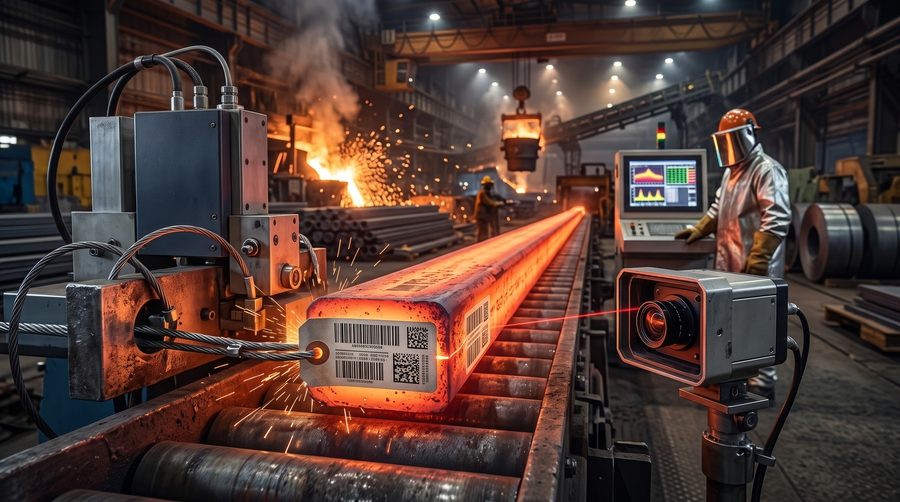
In the spark-lit casting bays of heavy metallurgical plants, where red-hot billets and massive coils move down processing lines, the concept of error tolerance becomes entirely meaningless. During the solidification phase of molten steel poured from ladles at temperatures exceeding 1000°C, identifying products while they still radiate hundreds of degrees of heat is the primary link where global metal traceability begins. Under today’s demanding heavy industrial conditions, if identification tags attached to slabs, billets, structural profiles, pipes, or hot-rolled coils melt, ignite, or carbonize into illegibility, multi-million-dollar alloy batches can be scrapped or misrouted to the wrong production facilities.
In this extreme environment where standard polyethylene or coated paper facestocks incinerate within seconds, high-temperature specialty metallized synthetic labels take over. Capable of adhering directly to red-hot metal surfaces or secured onto glowing billets via mechanical pinning, stapling, and metal strapping, these labels represent far more than simple identification plates. They serve as strategic quality certificates carrying alloy grades, heat/cast numbers, tensile strength ratings, and GS1-compliant 2D DataMatrix codes. A high-temperature metal labeling solution in the iron and steel sector guarantees uncompromising operational safety throughout the entire journey—from the casting bay to open-air port terminals.
High-Temperature Label Material Architecture Engineered for Red-Hot Metals
The surface temperature of products exiting hot-rolling mills in steel manufacturing typically ranges from +300°C to +600°C; at certain continuous casting discharge points, brief thermal contact temperatures approach +800°C. Industrial labels engineered to endure these severe conditions rely on a multi-layer specialized material architecture:
- Inorganic and Ceramic-Coated Synthetic Substrates: Instead of standard plastic films, aluminum-foil-laminated composites, glass-fiber-reinforced synthetics, or specialized ceramic-coated polyimide carriers are deployed. When brought into direct contact with incandescent steel, these materials do not ignite, shrink, or blister, maintaining millimeter-level dimensional stability.
- Extreme-Heat-Resistant Inorganic Adhesives: Formulations applied directly to hot metal surfaces replace standard adhesives with high-temperature-curing inorganic silicone or ceramic-based adhesives. Instead of melting and off-gassing, these adhesives undergo molecular-level thermal bonding directly with the steel surface.
- High-Tear-Strength Hang Tags and Strapping Tags: On rough cast billets or rebar bundles where surface adhesion is unfeasible, tags are fastened using steel binding wire or metal banding. Exposed to crane shocks, hook abrasion, and rough intermodal transport, these hang tags are manufactured from biaxially oriented, heavy-gauge tear-resistant synthetic polymers.
Open-Air Stockyards and Aggressive Environmental Durability Standards
The journey of steel products does not end at the mill exit; massive steel coils and structural sections are staged for months across seaport storage yards, shipyards, or open-air stockyards. Throughout this storage lifecycle, the environmental hazards labels encounter are just as destructive as melt shop temperatures:
- UV and Extreme Climate Resistance: Labels exposed to scorching sun for months must resist yellowing and embrittlement, just as they must not crack under sub-zero winter freezes. Specialized topcoats scatter ultraviolet radiation, preserving polymer integrity.
- Salt Spray and Acid Rain: Coastal maritime salt spray and airborne industrial sulfur gases accelerate corrosion on standard metal plates. Metallized synthetic labels remain chemically rustproof, providing a complete barrier against saline humidity.
- Protective Oiling and Acid Pickling Processes: Protective slushing oils applied to prevent sheet rust, as well as acid pickling baths, dissolve conventional label printing within seconds. Industrial-grade high-temperature labels remain chemically inert against heavy lubricating oils and hydrocarbon solvents.
Global Hardware Fleets Powering Uninterrupted Data Capture in Heavy Industry
Rapidly identifying hot metals within milliseconds across casting bays and overhead crane zones requires the deployment of field-tested, industrial-grade hardware. Key global technologies supporting heavy metallurgical operations include:
Heavy-Duty Industrial Barcode Printer Systems
Printing legibly on heavy-gauge metallized synthetics, aluminum barrier tags, and rigid hang cards demands high mechanical torque and printhead pressure. Operating 24/7 adjacent to dusty, oily, and vibrating production lines with a cast-aluminum chassis, the armored Zebra ZT610 industrial series represents the global benchmark for metal labeling workflows. The metal-framed Zebra ZT411 and the durable mid-to-high tier Zebra ZT231 deliver chemical-resistant, indelible label printing performance when paired with industrial Full Resin ribbons.
The Honeywell PM45 industrial series, known for its durable mechanical structure, alongside the reliable Honeywell PC42t desktop models for standard shipping documentation, serve as dependable assets within plant logistics. In metallurgical testing labs, chemical spectrometry rooms, and weighbridge stations, compact desktop printers such as the Zebra ZD421 and Zebra ZD220 provide streamlined, space-saving operation.
Extended-Range (ER) Rugged Barcode Scanners
Approaching hot coils and stacked billets on foot is hazardous and often physically impossible due to radiant heat. Operators across steel yards require the ability to decode identifiers from safe distances. Equipped with extended-range (ER) optical engines, the rugged corded Zebra DS3608 and cordless Zebra DS3678 series decode barcodes on glowing metals from distances exceeding 20 meters without requiring the forklift driver to dismount.
The Datalogic PowerScan and Datalogic QuickScan series, which confirm successful reads via patented Green Spot visual feedback, work alongside optical engine specialists such as the Honeywell Voyager 1250g, Honeywell Xenon Ultra, and the ultra-rugged Honeywell Granit barcode scanner line to eliminate data collection bottlenecks across outdoor yards. For packaging benches and static scale stations, corded Zebra DS2208 and cordless Zebra DS2278scanners handle localized barcode reading tasks.
Mobile Terminals Built for Crane and Forklift Operations
Managing material movements across expansive outdoor stockyards and crane bays requires specialized mobile computing hardware. Featuring physical keypads and integrated gun-grip ergonomics, the rugged Zebra MC3300 mobile computer allows operators to work accurately even while wearing heavy foundry gloves. For yard dispatch, loading ramp verification, and mobile scale auditing, the Android-based Zebra TC21, cellular-enabled Zebra TC26, and long-battery Honeywell EDA52 mobile terminals provide real-time data synchronization with central ERP systems.
For automated profile finishing and packaged steel lines, Weber modular applicators enable touch-free labeling on moving conveyor lines. The cost-effective Weber Alpha Entry, the adaptable Weber Alpha Compact, and high-speed Weber Alpha HSM modular labeling systems join dynamic industrial weighing solutions like the Bizerba GLP and Bizerba GLM-I to ensure accurate net-weight recording and rapid dispatch labeling.
Preventative Hardware Maintenance for Metal Production Lines
In environments filled with conductive airborne iron dust, extreme radiant heat, and graphite particles, implementing proactive technical care prevents unplanned printer and scanner downtime:
- Clearing Metallic Particulates from Printheads and Rollers: Conductive iron and carbon dust entering printer cabinets can cause printhead element shorts or physical abrasion. Cleaning printheads and platen rollers with isopropyl alcohol during every ribbon change prevents element failure; enclosing printers in positive-pressure protective cabinets extends operational lifespan.
- Deploying High-Heat-Rated Full Resin Ribbons: Standard wax or hybrid ribbons flash-evaporate under the radiant heat of glowing metal. Using specialized industrial Full Resin ribbons formulated to withstand temperatures of at least +300°C ensures a durable chemical bond with metallized label substrates.
- Optical Scanner Lens Maintenance: Scanner windows deployed on forklifts and crane cabins accumulate oily soot and dust over time. Periodic cleaning with anti-static lens solutions preserves fast first-pass read rates and prevents conveyor bottlenecks.
Uncompromising Reliability in Heavy Industry with DGS Printing Technologies
Operating reliably under extreme metallurgical heat and aggressive outdoor conditions requires an engineering-driven approach, certified consumable selection, and field-tested technical support.
DGS Printing Technologies (dgs.com.tr) delivers end-to-end identification solutions for steelmakers, offering ceramic- and aluminum-reinforced synthetic labels that mount directly to hot metal, tear-proof hang tags, ultra-high-temperature Resin ribbons, and heavy-duty industrial hardware. We configure production lines with Zebra, Honeywell, Datalogic, Bizerba, and Weber industrial barcode printers, ultra-rugged mobile computers, extended-range scanners, and automated applicators tailored to throughput speeds, slab temperatures, and yard layouts, supported by adaptable supply agreements.
Beyond hardware supply, DGS provides on-site line audits, system integration, original OEM spare parts replenishment (600 DPI and 300 DPI printheads, platens, sensors), and scheduled preventative maintenance contracts carried out by dedicated technical engineers. In today’s competitive steel markets, eliminate heat-number mix-ups and protect global product traceability with DGS’s material engineering and hardware integration capabilities. For high-temperature steel mill labels, industrial hardware, and technical field service, DGS serves as your professional solution partner.