In today’s logistics ecosystem—where order fulfillment times are measured in minutes, same-day delivery standards dictate market share, and e-commerce volumes reach historic peaks—the most expensive commodity in warehouse operations is time. Across every touchpoint, from receiving docks and high-bay storage aisles to order picking stations and packaging lines, every physical movement an operator makes directly shapes labor efficiency. In conventional warehousing models, operators using standard pistol-grip mobile computers or corded handheld scanners must constantly put down their devices to handle goods, only to pick them back up moments later.
These seemingly trivial few seconds spent “setting down and picking up” equipment compound into hundreds of lost labor hours and severe operational bottlenecks across high-throughput distribution centers processing tens of thousands of parcels daily. Portable barcode scanner technologies worn on the finger or the back of the hand fundamentally transform warehouse ergonomics by freeing both hands (hands-free operation), effectively doubling picking speeds. Doubling warehouse speed with portable barcode scanners is not merely a hardware upgrade—it is a strategic operational transformation that minimizes cycle times and eliminates error rates across modern intralogistics workflows.
The Powerful Impact of Hands-Free Operation on Intralogistics
Analyzing the movement ergonomics of picking personnel in traditional setups reveals that substantial operational time is spent positioning devices rather than handling merchandise. Portable scanning technology eliminates this bottleneck through measurable operational advantages:
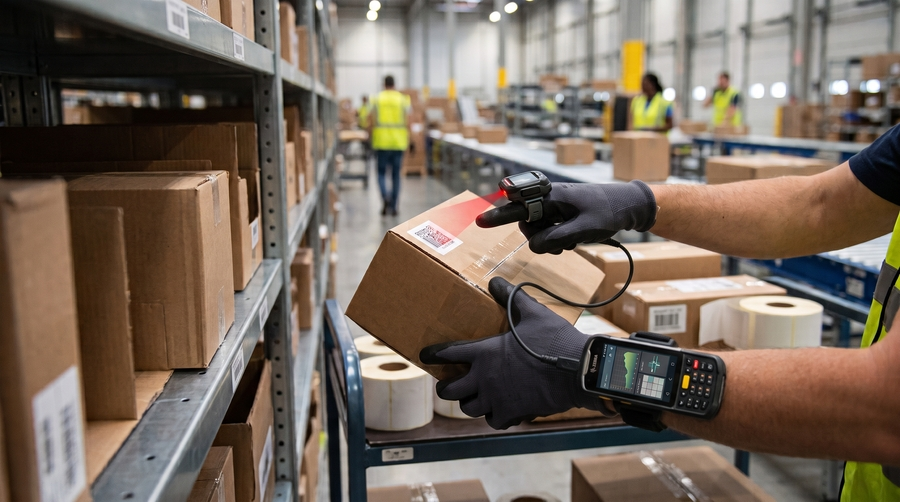
- Cumulative Seconds Saved: Using a traditional mobile computer or handheld scanner requires the operator to holster the device, set it on a workstation, or balance it in one hand while lifting an item. This cycle consumes an average of 4 to 6 seconds per pick. With a finger-worn ring scanner, barcodes are scanned directly as items are pulled from the rack; eliminating the need to set the device down saves a net 4 to 5 seconds per pick. For an operator handling 1,500 picks per shift, this yields roughly 2 hours of reclaimed productive time daily.
- Natural Dual-Handed Ergonomics and Workplace Safety: Handling heavy, bulky, or dual-handed cartons while clutching a device in one hand escalates the risk of drops, product damage, and musculoskeletal injuries. Portable solutions keep both hands completely free, establishing a balanced, ergonomic, and secure handling environment.
- Real-Time Picking Verification: Portable systems pair seamlessly with wrist-mounted portable mobile terminals or industrial smart displays. If an operator pulls the wrong SKU from a shelf, the finger-worn scanner provides instant haptic (vibration) or audible feedback, stopping errors before items enter the tote and cutting reverse logistics costs at the source.
Technical Dynamics of Ring Scanners and Back-of-Hand Systems
Portable scanning hardware comprises single- or dual-finger units as well as trigger-integrated modules mounted on the back of the glove. Maintaining peak performance in rigorous warehouse settings requires several critical technical capabilities:
- Advanced 2D Image Scanning Technology: Modern distribution centers rely heavily on both standard 1D linear barcodes and dense 2D symbologies like DataMatrix and QR codes. A quality ring scanner must capture and decode compromised barcodes—including wrinkled polybags, shrink-wrapped pallets with high glare, and damaged labels—within milliseconds.
- Bluetooth Low Energy (BLE) and Seamless Pairing: Portable scanners connect to wrist terminals, vehicle-mount forklift computers, or fixed workstations over low-latency Bluetooth protocols. Integrated NFC (Near Field Communication) enables “Tap-to-Pair” functionality, allowing personnel to pair their ring scanner with a wrist terminal simply by touching it, ready to work within seconds at the start of a shift.
- Modular Hygiene and Battery Architecture: In multi-shift operations, the optical scan engine remains in service while contact straps or glove mounts should be individually assigned, swappable, and washable. Furthermore, hot-swappable batteries allow battery changes without rebooting the system, ensuring uninterrupted 24/7 continuous operation.
Global Hardware Integrations Powering Warehouse Automation
Portable barcode scanner solutions are not standalone gadgets; they operate as part of an integrated data ecosystem synchronized with wrist terminals, industrial printers, and conveyor sorting lines. Standard hardware platforms driving operational efficiency across enterprise facilities include:
Zebra Portable Mobility and Ring Scanner Architecture
Setting global benchmarks in industrial portable technologies, the Zebra RS5100 single-finger Bluetooth ring scanner delivers an ultra-lightweight design, IP65-rated durability, and ambidextrous usability. For freezer environments or heavier industrial operations, the dual-finger Zebra RS6000 series provides ruggedized resilience. When paired with the armored, wrist-mounted Zebra WT6300 portable mobile computer, operators gain an accessible, real-time WMS display that accelerates pick paths.
For broader warehouse mobility, physical-keypad handhelds like the Zebra MC3300 series anchor loading dock and receiving operations, while Android-driven enterprise units such as the Zebra TC21, the cellular-enabled Zebra TC26, and the Honeywell EDA52 provide dependable mobile data capture across lighter field tasks.
High-Resolution Industrial Barcode Printers
First-pass read rates with portable scanners depend heavily on label print quality throughout racks and cartons. Across heavy-duty production lines running 24/7, the metal-framed Zebra ZT411, the high-resolution Zebra ZT231, and the flagship Zebra ZT610 utilize thermal transfer technology to produce durable, high-contrast barcodes resistant to smudging.
The rugged Honeywell PM45 series and the cost-effective Honeywell PC42t handle high-volume paper and thermal carton labeling, while compact desktop models such as the Zebra ZD421 and Zebra ZD220 optimize bench space at packing stations.
Extended-Range Scanning Ecosystem and Automated Applicators
At packing benches and shipping lines, corded Zebra DS2208 and cordless Zebra DS2278 imagers rapidly read reflective shipping bags. For forklift operators scanning pallet tags on high racking from meters away, ultra-rugged extended-range imagers like the Zebra DS3608 and cordless Zebra DS3678 (ER) provide reliable long-distance capture. Datalogic PowerScan and QuickScan series featuring patented Green Spot visual feedback, alongside Honeywell Voyager 1250g, Xenon Ultra, and heavy-duty Granit scanners, minimize human scanning errors across distribution networks.
For high-speed, untouched label application along automated conveyors, Weber modular applicators automate the flow: the entry-level Weber Alpha Entry, the adaptable Weber Alpha Compact, and the high-speed Weber Alpha HSM match demanding conveyor speeds, complemented by dynamic checkweighing and labeling systems like the Bizerba GLP and GLM-I series.
Best Practices for Battery Health and Hardware Longevity
Because portable ring scanners utilize compact battery cells to maintain their lightweight profile, standard operational practices help prevent mid-shift battery depletion:
- Multi-Slot Cradle Discipline: Operators should place ring scanners into 4-slot or 8-slot charging cradles during scheduled breaks rather than leaving them idle on packing benches. This routine prevents deep discharge cycles and preserves overall battery service life.
- Optical Window Maintenance: Industrial dust and airborne particulates gather on scanner exit windows over time. Buildup degrades scan engine focus and forces repeat trigger pulls. Regularly wiping optical lenses with microfiber cloths sustains immediate first-pass read rates.
- Trigger Mechanism Inspections: Finger triggers endure thousands of actuations per shift. Routine mechanical checks and proactive replacements of worn trigger straps prevent mechanical downtime before failure occurs.
Accelerating Intralogistics Through DGS Printing Technologies
Doubling order picking speeds requires more than purchasing a ring scanner—it demands a tailored hardware architecture aligned with your facility layout, WMS infrastructure, and operator ergonomics.
DGS Printing Technologies (dgs.com.tr) engineers end-to-end modernization initiatives for logistics facilities through its portfolio of industrial portable mobility solutions, extensive consumables inventory, and specialized systems integration expertise. Whether your operations require Zebra, Honeywell, Datalogic, Bizerba, or Weber portable systems, barcode printers, mobile terminals, or automatic label applicators, DGS delivers tailored implementations structured for clear return on investment.
Beyond hardware supply, DGS provides full-lifecycle support: on-site site surveys, WMS/ERP device integration, genuine spare parts fulfillment, and scheduled preventive maintenance handled by specialized technical service teams. To streamline order fulfillment cycles and equip your workforce with hands-free mobility, DGS serves as your dedicated integration partner for portable hardware and intralogistics automation.